
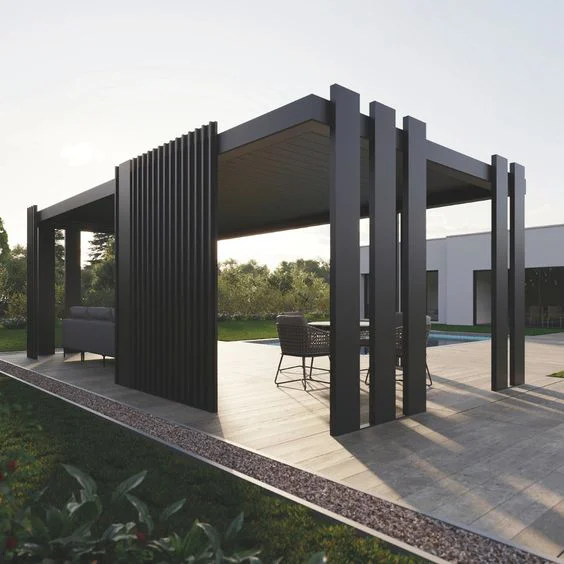
Dora Pergola, founded in Kartal, Istanbul in 2026, is a manufacturing and installation brand specializing in awnings, tarpaulins, and shading systems. Our founder Hakan Dora combined his 5 years of production and field experience in the sector under his own brand. Being a young brand allows us to focus on a single goal: transforming outdoor spaces into durable, aesthetic places that can be enjoyed in comfort all year round. With quality materials, sound engineering, and a customer-focused service approach, we turn your terrace or your business's outdoor area into a true living space for you.
At the center of our product range are modern outdoor roof systems. Alongside bioclimatic pergola systems, which manage sun, shade, rain, and ventilation from a single system with adjustable aluminum louvers, we offer motorized fabric roofs (rolling roof) and uniquely designed pergola solutions. Completing these systems with guillotine glass, sliding glass, folding glass, and zip blind applications, we also enclose the sides of outdoor spaces to keep the area protected in all weather conditions; with our awning and canopy solutions, we also meet economical and flexible shading needs.
What sets Dora Pergola apart is that we handle the entire job under one roof. Every project begins with a free site survey at your location; we assess dimensions, facade, wind load, and your usage scenario together, then recommend the most suitable system for your needs. Thanks to our own production infrastructure, we manufacture systems to the exact measurements of your space, install them precisely with our experienced team, and deliver them to you turnkey. The materials we use are selected for proven quality, built to withstand outdoor conditions and last for years.
The experience our founder and team have accumulated in the industry is directly reflected in the projects we deliver. We work across a wide range, from public projects such as Bergama National Garden and Çatalca Municipality to villa terraces, cafe and restaurant outdoor areas, and export projects reaching France. Our selected products are also available to our customers in Bauhaus stores.
For us, a project's success is not shown on delivery day; it is shown years later when it still performs like it did on day one and our customer remains satisfied. Because customer satisfaction is always our priority. If you want to turn your outdoor space into a livable, comfortable, and valuable area in every season, just contact us for a free site survey.

At Dora Pergola, our mission is to turn people's open areas into four-season-livable, comfortable, safe and aesthetic living spaces. We believe that turning a terrace, garden or business outdoor space from an idle area that retracts in rain or overheats in summer into a living space used with pleasure in any weather directly increases people's quality of life.

At Dora Pergola, our vision is to become one of Turkey's most reliable and innovative brands in the field of outdoor systems, and to grow our place in the European market with our quality production. We aim to be the pioneer of technology-integrated, sustainable and aesthetic solutions that redefine the relationship people have with the open air.

An outdoor system is an important investment you will use for years; the success of this investment starts with choosing the right partner. Although there are many companies on the market, Dora Pergola clearly makes the difference with its own production infrastructure, engineering-based approach, transparent service understanding and strong after-sales support.
The questions we hear most, from bioclimatic pergolas to glass systems, from the survey to turnkey installation. The exact answer comes from a survey at your space.

Yes, we export and work on overseas projects. The applications we completed in France are a concrete example of our experience in this area. For work abroad we offer two models: producing and shipping the system with installation by a local team, or sending our own installation team to the project. Which is appropriate depends on the project's scale, complexity and the country.
For distant projects we carry out the survey from the measurements, photographs and any architectural drawings you send; if needed we inspect the space together by video call. For glass systems, where dimensional precision is critical, we share the measuring method step by step. Shipping, packaging and customs processes are stated as separate items within the quotation, so you see the total cost clearly from the outset. For overseas projects you can contact us by email or phone.
Fabric life varies with the type of fabric, the intensity of sun it is exposed to and how often it is used. Quality acrylic fabrics are expected to last 8-12 years on average, PVC-based fabrics 7-10 years, and micro-perforated screen fabrics over 10 years. On south-facing façades in direct sun all day this shortens; on shaded or north-facing ones it lengthens.
You can tell it is time to replace from several signs: noticeable colour fading, loss of tension and sagging, seams opening, cracking on the surface, or water starting to come through. When these appear, you do not need to replace the whole system; only the fabric is renewed and the system returns to its first-day performance. Fabric renewal is among the after-sales services we offer. To extend fabric life: clean it with a soft brush and soapy water when dirty, do not retract it while wet, and do not disable the wind sensor.
The difference comes from the engineering each system carries. An awning consists of support arms and a fabric. In a bioclimatic pergola, each louvre is a mechanical part that rotates independently; gear mechanisms, actuators and a motor are needed for their synchronised movement. In addition, an EPDM gasket system is designed so the louvres do not leak when closed, along with a concealed gutter channel integrated into the beams and a drainage line running inside the columns. All of this means extra material and extra production labour.
The structure differs too. A bioclimatic pergola is sized to carry its own weight, the load of the louvre mechanism, and snow and wind loads; its profile sections are far stronger than an awning's arms. In return the lifespan differs by the same margin: fabric is replaced every 5-8 years on average, while a properly made bioclimatic pergola serves for over 25 years. When you divide the investment by annual cost, the gap is much smaller than it first appears.
Yes. Because of their limited area, small balconies are in fact one of the applications where the most is gained. In these spaces we primarily recommend a column-free cantilever pergola or a cassette awning; neither takes up floor space, neither blocks passage, and both preserve the balcony's usable area. If the span is in the 2.5-4 metre range, even a cantilever bioclimatic pergola can be installed.
If you want to close the sides, the most efficient solution in narrow spaces is guillotine glass; because the panels gather at the top, they take no room from the floor or sides. Alternatively, a zip screen offers an economical, lightweight solution as a wind and rain barrier. Colour and profile choice matter on small balconies too: light colours and slim profiles make the space feel larger. Whatever the size in square metres, our survey service is free; we take measurements and develop solutions for small spaces with the same care.
A wooden pergola offers a warm, natural look, but outdoors it is a material that demands constant maintenance. Wood absorbs moisture, cracks in the sun and loses fibre through freeze-thaw cycles; it is exposed to fungus, mildew and insect risk. To extend its life, sanding, impregnation and varnish or oil application are needed roughly every 1-2 years. Without that maintenance, colour loss, rot and structural weakening appear within 5-10 years. Wood is also less suitable than aluminium for integrating motorised louvres or glass systems.
An aluminium pergola, by contrast, is protected against corrosion by a natural oxide layer and coated with electrostatic powder paint. It keeps its shape and colour against humidity, salty sea air and UV; it does not rot, crack or attract insects. Maintenance amounts to wiping it down with soapy water once or twice a year. Structurally, wider spans can be crossed with slimmer profiles, so systems that suit modern architecture and look visually lighter can be built. The service life of a properly manufactured aluminium pergola exceeds 25 years. If you like the look of wood, you can achieve the same aesthetic without the maintenance burden using wood-effect sublimation-coated aluminium profiles.